Thursday, May 9, 2013

Ethiopian integration in Israel Gaps remain in - JPost

Ethiopian students dropout rates highlight one of the many challenges facing the Ethiopian community in Israel, Shapira says.

State Comptroller Joseph Shapira hands Knesset Speaker Edelstein annual report, May 8
State Comptroller Joseph Shapira hands Knesset Speaker Edelstein annual report, May 8 Photo: Courtesy of Knesset

Despite the government’s significant efforts to advance the integration of Ethiopian immigrants into Israeli society, gaps still remain in various fields such as welfare, education and employment, according to the State Comptroller’s Report released on Wednesday.
As of 2012, some 120,000 citizens of Ethiopian origin live in Israel, as stated in the document, representing some 1.5 percent of the population. A third of them were born in Israel.
In the last few years, the country has seen an average of 1,500 immigrants from Ethiopia per year, half the rate of 10 years ago.
The report pointed out that over the past 20 years, the State of Israel has taken important measures and invested hundreds of millions of shekel to advance their integration through national programs.
Nevertheless, problems remain, the report stated.
In the field of education, the report revealed that in the 2010-2011 academic year, only 1,000 out of the 12,546 students enrolled in pre-academic programs were of Ethiopian origin.
Some 28.5% of Ethiopians dropped out of the programs compared to 22% for the rest of the students.
Among the Ethiopians who finished the pre-academic programs, more than half did not go on to study at universities, compared to 41% for the rest of the students.
In addition, the dropout rate for Ethiopian students who began their studies in 2011 was 19%, some 8% higher than the rest of students. In private colleges, 13.5% of Ethiopian students dropped out, compared to only 10% for the rest of the population.
Also, out of 22,000 engineering and technology students, only 194 were Ethiopian.
Over the past few years, immigrants joining the IDF have made up about a fifth of the general number of soldiers.
The majority of these olim come from the former Soviet Union and Ethiopia.
According to data presented in the report, 5,800 Ethiopian soldiers served in the army at the end of 2010. In that same year, 2,430 of them had begun their service. The report stated that despite their high motivation to join the IDF, Ethiopian soldiers tend to experience problems during their service. In 2010, only 9% of them had gone through professional training and took courses for their military positions.
The report also showed that Ethiopians are much less represented than the rest of the population in government roles and the public sector. But in local authorities and municipalities, Ethiopians are more represented than they are in other fields.
According to the report, despite investing significantly in the integration of Ethiopian immigrants, the Israeli government has never evaluated the effectiveness of these measures, which represents “great waste.”
“Improving the situation of the Ethiopian community in Israel in these fields will advance, in the best possible way, their integration into the general Israeli society, both in terms of their socioeconomic conditions as well as in their feeling of belonging,” the report stated.
The state comptroller suggested that the issue of integrating Ethiopian immigrants into Israeli society should be handled by one exclusive body that will “see the big picture” and better coordinate between the different areas of concern.

Monday, April 15, 2013

Obama and the "Flasha" Biet Israel Miss Israel Yityish ‘Titi’

Posted by: Carma Henry 


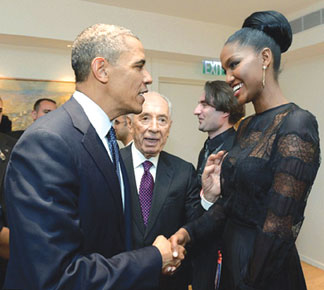
President Barack Obama meets Yityish ‘Titi” Aynaw
President Obama meets first Black Miss Israel Yityish ‘Titi’ Aynaw,
Submitted by Daniel Estrin
        Daniel Estrin of PRf’s The World is reporting that during President Obama’s visit to Israel, the United States’ first Black President met Yityish Titi’ Aynaw, Israel’s first Black Miss Israel at a state dinner. Aynaw, an Ethiopian Jewish immigrant, is the newly crowned 2013 Miss Israel.
    Israel has had contentious relationships with Ethiopian Jews and most recently admitted to making Ethiopian Jewish women take birth control as a condition of immigration. This most recent issue reflects the discrimination the Ethiopian Jews routinely face in Israel, an example of which is blood donation. In the 1990s, it was discovered that the Israeli national blood bank routinely destroyed blood donated by Ethiopians.
    According to CNN, President Obama requested Miss Anaw’s presence at the state dinner. Miss Aynaw was crowned Miss Israel, making history as the first Black woman to wear the crown since 1950.
0000000000000

Barack Obama invites first black Miss Israel to dinner

Yityish Aynaw, the first Ethiopian-born pageant winner, said the US president had been a ‘notable influence in her life’
Yityish Aynaw Miss Israel President Obama
Yityish Aynaw arrived in Israel from Ethiopia when she was 12 years old and admitted it was initially difficult for her to assimilate into Israeli society. Photograph: Avishag Shar Yashuv/EPA
It will be one of the hottest tickets in town. When the US president,Barack Obama, arrives in Israel on an official visit next week, one of the highlights for the country’s dignatries will be a dinner hosted at Israeli president Shimon Peres’s home. And among those set to dine with the two presidents is the first black Miss Israel, Yityish Aynaw.
When the president’s staff called to invite her to the dinnerAynaw, who was crowned just a few weeks ago, was understandably taken aback. “I didn’t believe this was happening,” she told the Jerusalem Post.
Aynaw arrived in Israel from Ethiopia when she was 12 years old. The beauty queen, who has worked as a sales assistant since leaving the army, has admitted that it was initially difficult for her to assimilate into Israeli society. Despite being 100,000 strong, the Ethiopian Jewish community is marginalised in Israel, where some rabbis have questioned the authenticity of their Jewish faith.
In the course of the Miss Israel competition, Aynaw told the panel of judges: “It’s important that a member of the Ethiopian community win the competition for the first time. There are many different communities of many different colours in Israel, and it’s important to show that to the world.”
On learning that she would be dining with the US president alongside the Israeli leadership, Aynaw admitted that as a young immigrant, she would not have believed “such a thing could happen” to her. Once the news sunk in, however, the 21 year-old former Israeli army officer declared herself “excited” and reasoned: “The first black Miss Israel to be chosen and [Obama] is the first black American President. These goes together.”
Obama, she said, has had a “notable influence in her life”.
Shortly after winning the title, Aynaw named assassinated US civil rights leader Martin Luther King as one of her heroes: “He fought for justice and equality, and that’s one of the reasons I’m here: I want to show that my community has many beautiful qualities that aren’t always represented in the media.”
While she may have embraced her life in Israel, Aynaw has refused to adopt a Hebrew name as many of African immigrants have done. “I was born sick but my mum believed I had a future,” she told Jewish publication The Tablet, explaining that her name in Amharic, the second most spoken Semitic language in the world after Arabic, means “looking towards the future”. “I’d never change my name,” she said. “Ever”.
With African roots and controversial names in common, Miss Israel and President Obama have ample mutual ground to break the ice.

Saturday, March 23, 2013

Ethiopian Jewish Community From Christianism to Judaism

  • Facilitated by the Israeli government, a young couple and their children are going on aliyah from Ethiopia — a purposeful ascent, or "going up" to Israel. The facial cross tattoos, often sought to hide their Jewish origins, are frequently removed once they have arrived in Israel.
    Facilitated by the Israeli government, a young couple and their children are going on aliyah from Ethiopia — a purposeful ascent, or "going up" to Israel. The facial cross tattoos, often sought to hide their Jewish origins, are frequently removed once they have arrived in Israel.
    Ilan Ossendryver
  • An elderly couple, ready for their long-awaited move to Israel, June 2011.
    An elderly couple, ready for their long-awaited move to Israel, June 2011.
    Ilan Ossendryver
  • Woman sculpting a clay pot in Addis Ababa, the capital of Ethiopia, June 2011.
    Woman sculpting a clay pot in Addis Ababa, the capital of Ethiopia, June 2011.
    Ilan Ossendryver
  • Woman with menorah in Addis Ababa, June 2011.
    Woman with menorah in Addis Ababa, June 2011.
    Ilan Ossendryver
  • Man with Star of David in Addis Ababa, June 2011.
    Man with Star of David in Addis Ababa, June 2011.
    Ilan Ossendryver
  • Paint on the side of a Jewish school in Gondar, Ethiopia, reads "Welcome Nacoej, Talmud Torah Class," June 2011.
    Paint on the side of a Jewish school in Gondar, Ethiopia, reads "Welcome Nacoej, Talmud Torah Class," June 2011.
    Ilan Ossendryver
  • Students at a Jewish school in Gondar, June 2011.
    Students at a Jewish school in Gondar, June 2011.
    Ilan Ossendryver
  • Men at morning prayers touch the Torah Scroll with the fringe of their prayer shawls at a Jewish compound in Gondar, June 2011.
    Men at morning prayers touch the Torah Scroll with the fringe of their prayer shawls at a Jewish compound in Gondar, June 2011.
    Ilan Ossendryver
  • Ethiopian men and women at morning prayer with a traditional dividing curtain between them, Gondar, June 2011.
    Ethiopian men and women at morning prayer with a traditional dividing curtain between them, Gondar, June 2011.
    Ilan Ossendryver
  • As of summer 2011, approximately 5,000 Beta Israel remain in Ethiopia anxiously waiting for an opportunity to join friends and family who are now in Israel.
    As of summer 2011, approximately 5,000 Beta Israel remain in Ethiopia anxiously waiting for an opportunity to join friends and family who are now in Israel.
    Ilan Ossendryver

1 OF 10
View slideshowi
For South African photojournalist Ilan Ossendryver, photographing the Ethiopian Jewish community, also known as Beta Israel, started out professional but ended up personal.
His decades-long body of work is now represented in the exhibit "Beta Israel: Ethiopian Jews and the Promised Land," at the Oglethorpe University Museum of Art in Atlanta.
Ossendryver admits that he didn't know much about Ethiopian Jews before receiving an assignment years ago to cover their migration to Israel. Turns out that assignment wasn't so easy.
He recalls one of his first stops — an "absorption center" — in the southern Israeli town of Ashdod, where immigrants learn Hebrew and "get acclimatized to living in Israel."
He brought his camera, "but they weren't very happy about photography at the time."
The newly arrived immigrants were shy and uncomfortable about being photographed. But Ossendryver wanted to capture what he saw as resilience in a community stuck between two cultures in two countries.
His images offer a snapshot into the contemporary life of a community with a history that may not be well-known to many. And it may not be well-known because it is not entirely clear.
The contested origin story of the Ethiopian Jewish community has made the ongoing migration to Israel — which has happened in waves for decades — a complicated one.
Jewish ancestry determines whether one has a right to Israeli citizenship. Over the years, many Ethiopian Jews have lived as Christians, for example, to escape persecution — often going as far as tattooing crosses on their foreheads.
For Ossendryver, photography can do what historical analysis and DNA testing can't: examine how the community actually lives today.
The exhibition actually shows two groups: One still in Ethiopia, striving to make sense of its identity and trying to blend in while sustaining its traditions; the other group is seeking to carve out a new life in Israel.
The journey to Israel is one that the majority of Ethiopian Jews have shared in recent decades. According to the Israeli Central Bureau of Statistics, more than 78,000 Ethiopians have immigrated to Israel since 1980. By some estimates, only a few thousand remain in Ethiopia.
Getting to Israel isn't easy — and life for those who get there isn't easy, either, according to Ossendryver.
Recent events in Israel — like the vigorous and ongoing debate around immigration from Africa,accusations of discrimination and the recent news of Ethiopian immigrants being forcibly injected with birth control have also highlighted some tensions the community has faced within the country.
Even in the face of this adversity, Ossendryver says most Jews in Ethiopia have their eyes on Israel.
Ossendryver says one of his favorite scenes was a Jewish school in Gondar, Ethiopia. There, he says, students don't have to choose between two worlds.
"It's a really beautiful school. You'll see there's a picture of Africa, there's a picture of Israel and a picture of Ethiopia all in Amharic," the official language of Ethiopia, he recalls. "I found that quite nice to see."

Thursday, March 21, 2013

Yityish Aynaw: First black Miss Israel will go to the ball. BBC News


Yityish Aynaw and her brother Yellek
It's been an astonishing three weeks for Yityish Aynaw, an immigrant orphan from Ethiopia, who became the first black Miss Israel last month, and has now been invited to Thursday's gala dinner with visiting US President Barack Obama.
When Yityish Aynaw arrived in Israel as a 12-year-old, winning beauty contests and dining with presidents was as far from her thoughts as her native Ethiopia is from her adopted land.
Her mother had just died, leaving her an orphan - her father had died years earlier. So her mother's parents, who were among thousands of Ethiopian Jews already living in Israel, arrived in Addis Ababa to fetch Yityish and her older brother.
In their new home, they had to learn Hebrew from scratch.
"It wasn't easy because I couldn't speak the language and I was put into a regular class without any help," Aynaw, now 21, told the BBC World Service.

Find out more

Yityish Aynaw (Laisha Magazine)
Yityish Aynaw was interviewed on the BBC World Service programme Newshour
"It was a new language. It was a new culture. Quite often children even laughed at me," she says, though she adds that she also met many kind people.
But Aynaw was determined to succeed in her adopted country.
"I felt a responsibility to prove myself in everything I did and to improve myself as well," she says.
After school, like most other Israelis, she performed military service. She then stayed on in the army and was serving as an officer when she left, after three years, in September last year.
Before she was selected as Miss Israel on 27 February, she was a manager in a shoe shop in Netanya.
"For people from my country of origin it is a source of great pride," she says of her new title.
During the competition she named the black American civil rights leader Martin Luther King as one of her heroes.

“Start Quote

Her victory is great for us because it shows that the most beautiful woman is black and that people accept difference”
Penina Tamanu-ShataEthiopian Israeli MP
"He fought for justice and equality, and that's one of the reasons I'm here. I want to show that my community has many beautiful qualities that aren't always represented in the media," she said at the time.
But another hero, she told the BBC, was the US president.
"I was influenced and inspired by Obama. Like him, I was also raised by my grandmother. Nothing was handed to me on a plate and like him I also had to work very hard and long to achieve things in my life. To this day he inspires me just as he inspires the rest of the world," she says.
"I couldn't believe that one of the most influential people in the world, the head of such an important state, would invite someone like me to attend such an important event. It has only just now sunk in and I can understand that it's happening.
"It is a great honour not just for me, but the other people that I represent."
Aynaw says she hopes her victory will "achieve the acceptance of everyone in Israel".

Ethiopian Jews

Ethiopian Jews in Netanya
  • Some 120,000 Ethiopian Jews live in Israel
  • Known as Beta Israel, they mostly came from northern Ethiopia
  • They speak the Semitic languages Amharic and Tigrinya
  • Many Ethiopian Jews believe they are descended from one of Israel's ancient tribes
  • Israel decided in the 1970s that its law allowing Jews the right of return applied to them
Ethiopians often complain about discrimination when it comes to jobs, education and housing. There were even allegations last year that some new Ethiopian immigrants have been given contraceptive injections against their will.
Aynaw's victory "was very important for all Israeli society", says Penina Tamanu-Shata, one of two Ethiopian Israelis currently serving as a member of the Israeli parliament, the Knesset.
"Her victory is great for us because it shows that the most beautiful woman is black and that people accept difference. Yityish won, but Israeli society also won. Her victory made a statement. She showed there are no limits."
Tamanu-Shata says the fact that the contest was shown on prime-time television was important as most Israelis encounter the Ethiopian community - just 120,000 strong - through the media.
"Sometimes the discrimination is under the surface. Most Israelis say they love the Ethiopian community, but there are still problems," she says.
"I think the situation is getting better, but we still have a lot of work to do."
Yityish Aynaw was interviewed on the BBC World Service programmeNewshour.
You can follow the Magazine on Twitter and on Facebook