
The Ark or Tabot is the Basis of the Ethiopian state Formation
Wednesday, June 7, 2017

Ethiopian immigrants land in Israel | The Times of Israel
72 new immigrants arrive in the country on the first of three expected flights for this month; some 9,000 Jews in Ethiopia are still waiting to come

Family members embrace at Ben Gurion Airport as 72 new immigrants from Ethiopia arrive on June 6, 2017. (Miriam Alster/Flash90)
Surrounded by Israeli flags and dozens of balloons, more than 200 families and supporters gathered at Ben Gurion Airport on Tuesday night to welcome 72 new Ethiopian immigrants to Israel, the first group to immigrate since the government “resumed” Ethiopian immigration last October.
When the new immigrants emerged into the airport’s arrival hall, a huge cheer went through the crowd, which rushed forward to embrace family members they hadn’t seen in over a decade. Youth group members formed a welcoming line, chanting, “We won’t be afraid, even if the road is long.”
“We’re not angry but we were worried, we were very worried,” said Adisu Berhanu, who was waiting for his 13-year-old niece, whom he had last seen before he moved to Israel when she was a year old. “But here, today, the worries are behind us. There’s always hope, we hope everyone will be able to make aliyah.”
There are approximately 9,000 Jews in Ethiopia with family in Israel who are waiting to emigrate.
In August 2016, a year after the government first announced it would bring those still awaiting immigration, the Finance Ministry agreed to allocate money to allow 1,300 Ethiopians to come, the first step of a five-year program to bring 6,000 new immigrants at a rate of approximately 100 per month.
Although a celebratory flight landed at Ben Gurion International Airport in October with 63 Ethiopians who had already received their approval to immigrate, this was the first plane to arrive since then. The process for immigration approval has been plagued by accusations of racism and inefficiency against the Interior Ministry.

A crowd of more than 200 people waited for the new Ethiopian immigrants on June 6, 2017 at Ben Gurion Airport. (Miriam Alster/Flash90)
Family members said they hoped Tuesday’s flight would signify a turning point. There are two additional flights planned for June, including one next week with almost 100 people, according to International Christian Embassy Jerusalem spokesman David Parsons. ICEJ is sponsoring the first year of flights for the Ethiopian immigrants.
“They were projecting 1,300 in the first year, but there was a six-month delay, so they need to catch up a little,” said Parsons. “But today you can really feel the joy and excitement of families reuniting after a long time of separation.”
Parsons said that African Christians have been especially passionate about donating to ICEJ to pay for the flights of Ethiopian Jews, including a group of Tanzanian Christians who paid for the flights of an entire family of eight people.
Other people were less optimistic, including many of the activists who are part of the Struggle for Ethiopian Jewry. “The Israeli public is so apathetic,” said Moges Siyum, one activist. “How is it that just us alone are fighting to bring these Jews home? They are a symbol of all of the Jewish people.”
More than 50 members of youth groups waited with homemade signs and small flags, including Bnei Akiva and Fighters for Hope, an organization that runs one-week service trips to Ethiopia for post-army and post-national service young adults.

Family members greet new arrivals from Ethiopia at Ben Gurion Airport on June 6, 2017. (Miriam Alster/Flash90)
“Coming here tonight is the least we can do to help them get off on the right foot,” said Tal Hadad, 18. “I wish [Israelis] would care a little bit more about this issue and accept people.”
Or Getahun from Kiryat Malachi was waiting with his grandfather for the daughter of his niece, whom he hadn’t seen in 15 years. His niece arrived on the October flight and has been eagerly awaiting the arrival of her daughter. His grandfather had never met his great-grandchildren. “It’s a sad story but ended with happiness,” said Getahun. “In my family there were so many reactions, some were angry, some were not, but at least it ended happily so the mom and daughter can meet.”

Many family members were separated for more than a decade before the reunion at Ben Gurion Airport on June 6, 2017. (Miriam Alster/Flash90)
Wednesday, March 22, 2017
Beta Israel reconsidered: Defending the Israelite ancestry of Ethiopian Jews | Genetic Literacy Project
PRINTER FRIENDLY

The Ethiopian Jews, who primarily relocated from Ethiopia to Israel through Israeli rescue missions in the 1980s, form a unique minority of today’s Israeli population. Back In Ethiopia, they were known as Falasha, meaning “strangers”, and have referred to themselves as Beta Israel, or “the house of Israel”. Their settlements were scattered in the northwestern area of Ethiopia and the border zone with the Sudan.
The approach and methodology of the conventional theory on the origins of the Ethiopian Jewry, as proposed by James Quirin, rejects the existence of an ancestral connection between the contemporary Ethiopian Jewish community and the ancient Israelite-Jews. Proponents of this theory trace the origins of the group to what they perceive as a local Ethiopian separatist movement within Christianity in the 14th-to-16th century.
The influence of this theory with regards to how the media continues to define the origins of the Ethiopian Jewry is overwhelming. A Newsweek article reports: “Historians still debate the precise origins of Ethiopia’s Jewish community but agree that it developed largely in isolation until the 20th century.” The statement reiterates the idea embedded in the traditional theory that the group has developed locally, “in isolation,” without an ancient Israelite connection. Although a majority of historians have subscribed to this hypothesis, not all scholars agree on its premises as the article’s authors insinuate. Scholars, such as David Kessler in his work The Falashas, argue that there is no persuasive reason to assume that the Ethiopian Jews descend from Christian separatists since their faith, among many other reasons, is an authentic form of Judaism that predates Christianity.
In my articles (here, here, and here), I have argued that historical sources and evidence overwhelmingly suggest that the group directly descends from ancient Israelite-Jewish origins. As I demonstrate, sources and evidence dating between the 1st to 4th centuries period and contemporary times point to the historical continuity of the Ethiopian Jews as a group. I stress that the group’s religious structure is fundamentally Jewish and that it is unreasonable to assume that it has developed locally, in what is today Ethiopia, without authentic Israelite contributions involving culture, religion, and genetics.
 I also base my argument on genetic research from Genetic Literacy Project founder Jon Entine’s book Abraham’s Children: Race, Identity, and the DNA of the Chosen People, which suggests that the group was formed when fragmented Jewish communities in the region amalgamated in the mid-first millennium. (Furthermore, I stress that the Ethiopian Jews share indisputable historical, geographical and probably genealogical connections with Northern Sudan that are yet to be examined by scholars in depth.)
 A genetic study that is rarely if ever mentioned in Ethiopian Jewish research was published by the highly regarded American Journal of Human Genetics. As the BBC reports, the study suggests that “Ethiopians mixed with Egyptian, Israeli or Syrian populations about 3,000 years ago.” Professor Chris Tyler-Smith, from the Wellcome Trust Sanger Institute, told the BBC: “By analyzing the genetics of Ethiopia and several other regions we can see that there was gene flow into Ethiopia, probably from the Levant, around 3,000 years ago, and this fits perfectly with the story of the Queen of Sheba.” Note that the study does not contradict the 2007 work by Entine or other historical evidence. The results suggest that Israelites-Jews entered the region 3,000 years ago, but they were not necessarily consolidated as a group until about 1,500 years ago. Also, note the study does not necessarily confirm the biblical story of affair between Queen Sheba of ancient Ethiopia and king Solomon of ancient Israel.
Worth mentioning is the research of the Iraqi Semitic languages specialist Jaafar Hadi Hassan in 2015. Hassan is widely considered one of the most renowned scholars in Iraq and the Arab world. In his research, he criticizes historians for assuming that the Scottish explorer James Bruce was the first to “discover” the existence of the Ethiopian Jewry in the second half of the 18th century. Hassan explains that the Arabs were closely acquainted with the Ethiopian Jews long before Bruce entered the picture.
One of the sources Hassan cites is the work of the 16th century Arab historian Shihab al-Din Ahmad al-Jizani. Writing in the first half of the 16th century, Shihab al-Din explains—as I translated from Arabic: “The Semien country belonged to the Jews of Abyssinia [in what is today Ethiopia] and their name in their language is Falasha [a local name for the Ethiopian Jews]” The Arab historian then goes on to describe interactions between the Ethiopian Jews and the Muslim leader Imam al-Ghazi.
More important is the 17th century Arab historian Al-Himi al-Hassan bin Ahmad. He states—as I also translated from Arabic:
” After completing seven phases, we contacted the country of the Falasha; the first of which is a great valley under a towering mountain of supreme grandiose and extreme height. The name of the valley is ‘Aghnah’ and the name of the mountain is ‘Semien’. “
He continues:
“This tribe they call Falasha is a large tribe, one of the greatest tribes in Abyssinia. Their faith is Judaism and they abide by the law of the Torah ( . . . ) They were not submissive to the king who invaded, fought, and assaulted them in all parts of their country so that he has surrounded them by the Christian country. He eventually defeated them and forced them out of their fortresses ( . . . ) Most of them converted to Christianity except for a small minority.”
Hence, it is certainly problematic from a scholarly standpoint when a BBC contributor writes, “The main challenge in tracing the origins of a Jewish presence in Ethiopia is the lack of reliable accounts”. We can conclude that since the influence of the traditional theory on the media and the scholarly scheme of research on the Ethiopian Jews is dominating, there is a need for a new unbiased approach to investigate the history and origins of the group.
Ibrahim M. Omer is a 3D Animation specialist with interest in the reconstruction of ancient historical settings. He has worked as an academic in the social science areas of linguistics, culture, and history. He is the author of the academic website AncientSudan.org.
Sunday, December 11, 2016
Ethiopian Judaism practiced during Second Temple Period-ynetnews
Dr. Yossi Ziv has been researching the religious rituals of the Ethiopian Jewish population still in Ethiopia and discovered that they maintained the same customs and traditions as the Jews of the Second Temple period for the past two thousand years.
"They have been curating ancient customs that have disappeared from the world. They provide examples of how the leaders of the nation of Israel would have behaved during the time of the Second Temple."

The professor released his findings at a seminar which was held at the Kfar Etzion Field School right before the Jewish-Ethiopian holiday of Sigid.
Ziv said that many Jewish-Ethiopian customs go against modern Jewish practice, but perfectly align with customs and rituals described on scrolls found in the Qumran caves and in books dating back to the Second Temple Period. The Qumran Caves are where the Dead Sea Scrolls were found, which include the third oldest Hebrew Bible ever found.
"They don't even adhere to the famous rule which says that 'Shabbat rules may be disregarded for the purpose of saving a life,'" Ziv said. "For the Ethiopian Jews, the sanctity of Shabbat must be preserved, even at the cost of human life."

Ziv added that there were different sects of Jews living during the time of the Second Temple—the Pharisees, Sadducees, Essenes, and Zealots—who all lived according to different beliefs and rituals. Jewish rituals and customs today mostly take after the Pharisee tradition.
The discrepancies between the more "modern" Jewish law and the law of the Ethiopian Jewish elders—known as the Kessim—can be seen in different areas of Jewish law.
According to mainstream Jewish custom, people in mourning refrain from cutting their hair or shaving their beards for a specified period of time, whereas Ethiopian custom is for mourners to cut their hair short and shave their beards—another tradition Ziv saw written in texts from the Second Temple Era.

"After the Prophet Job underwent his bad tidings, it is written that he cut his hair. It was also written in some of the writings of Isaiah and Ezekiel that the Jews would cut their hair short during periods of mourning," Ziv said.

This ritual purity is another reason why ritual circumcision is not carried out in Ethiopian Jewish synagogues. Therefore, the circumcisions are carried out next to the tent of the menstruating women, and often done by the women. It is only after the first 40 days after a boy is born that an Ethiopian mother can return to the village. If a girl is born, then the mother must wait 80 days. The baby naming would then occur in the village.
However, Ziv says that the customs and traditions of the Ethiopian Jews and their strong resemblance to Jewish traditions during the Second Temple Period only serve to strengthen their connection to Judaism as a whole.
"I'm convinced that this community was a part of the nation of Israel during ancient times, but they were cut off. We don't know when or why, but it occurred before the Pharisic tradition became the mainstream Jewish tradition," Dr. Ziv said."The Jews of Ethiopia lived in exile and in complete isolation from the rest of the nation of Israel. However, they continued to keep the traditions of our forefathers up until this very day."
"It’s knowledge which hasn't been written anywhere, and has been preserved in their traditions," the researcher said.
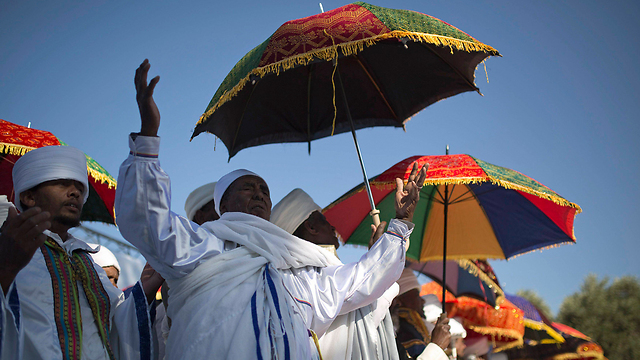
Israeli-Ethiopian elders performing the Sigid ritual in Jerusalem (Photo: Reuters)
Some of these Second Temple Era customs include not lighting Shabbat candles, adhering to an ancient custom prohibiting the use of fire lit even before Shabbat started. Along with this, no flame is to be passed from one vessel to another on Shabbat, even if it was lit before Shabbat came in.
Evidence of this stringent observance of Shabbat was also seen in the Dead Sea Scrolls.

Ethiopian women at the Sigid festival (Photo: Reuters)
Another example in the differences between mainstream Judaism and Ethiopian Judaism relates to sex during Shabbat. According to modern Jewish tradition, marital relations are not only permitted, but encouraged on the day of rest. Meanwhile, Ethiopian tradition holds that all sex is forbidden on Shabbat so as not to sully the body. Examples of this Ethiopian tradition have been found in the Dead Sea Scrolls.

Ethiopian Jewish women in Jerusalem at the Sigid ritual (Photo: Reuters)
Another prominent Ethiopian Jewish tradition is strict observance of purity laws. For instance, when a woman is menstruating in Ethiopian Jewish society, she is sent to live in a specified tent outside of the village until she becomes "pure" once again, as is prescribed to be done in the Temple Scroll of the Dead Sea Scrolls.
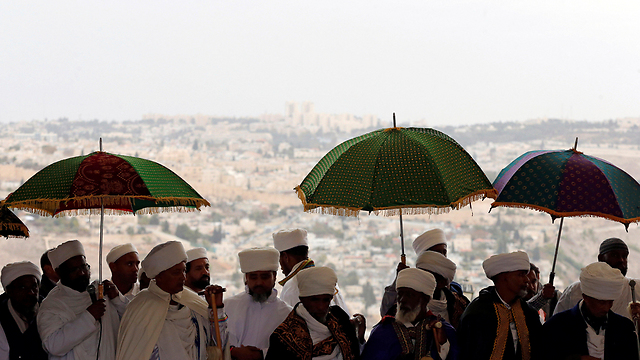
Kessim Israeli-Ethiopian leaders (Photo: Reuters)
'They were a part of us, but were then cut off'
The differences between the rituals and customs of mainstream Judaism and Ethiopian Judaism undermined the authority of the traditional Ethiopian Jewish leaders after they made aliyah to Israel, and even undermined the Ethiopians' claims that they are indeed Jews.
Subscribe to:
Posts (Atom)